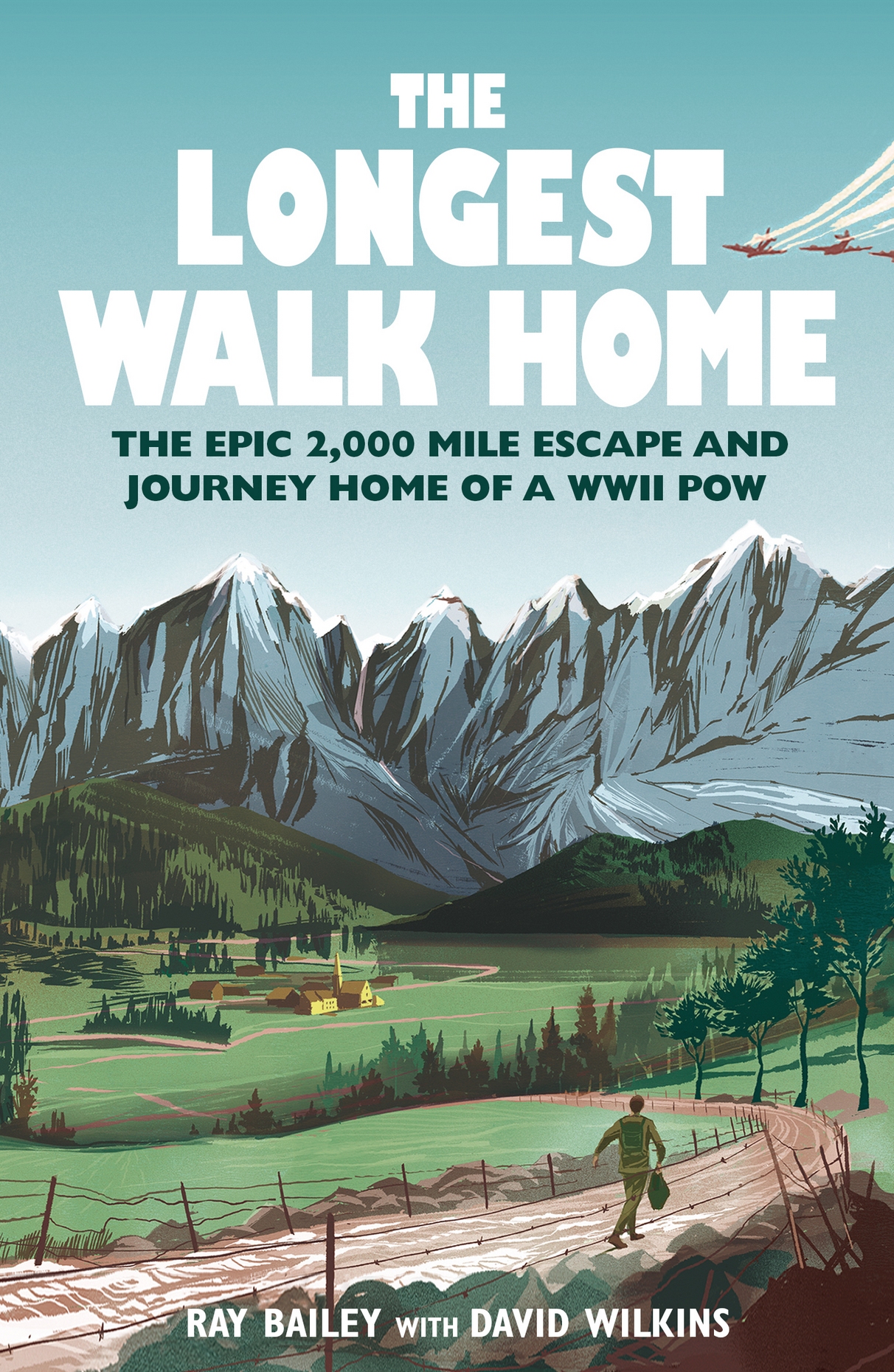
The Longest Walk Home
A cardboard box...
The adventures of Ray Bailey - the writer and hero of The Longest Walk Home - took place over the course of fourteen months, between October 1939 and December 1940. But the book embodies another story besides Ray's. This second story - explaining how the first story came to be told - happens more slowly. It took more than eighty years for that story to unfold.
In the summer of 2019, I was browsing an online auction, when I spotted an interesting lot. A couple of photographs showed a bunch of old notebooks and some loose papers partly in a cardboard box and partly spread out on a table. A few sentences had been added by way of description. Here, the seller said, was a collection of documents that related to a British soldier of the Second World War. The soldier seemed to have been captured in France by the Germans and it looked like he had somehow escaped and made it home.
I've been buying old diaries, collections of letters, photo albums and so on in auction salerooms for decades. Since the advent of internet marketplaces in the early 2000s, I've bought online too. I like the idea of rescuing people's forgotten stories. It's amazing what is still out there waiting to be found. In this case, the online seller's scant description suggested that he knew relatively little about the collection of material he had listed. That probably meant these were not documents from his own family. Perhaps the collection was being sold by a house clearance firm - or maybe it had been purchased speculatively at a live auction for re-sale online (this later turned out later to be the case). I bid for the box. But to my annoyance, I didn't win it. That seemed to be the end of that.
Several months later however, I was again idly browsing online when I came across the same lot being sold by the same seller. I emailed him to ask the obvious question; had the previous sale fallen through for some reason? It turned out that it had. The buyer had been in another country and the seller hadn't wanted the trouble of packing and posting a substantial box of papers overseas. This time I made no mistake. I emailed back straight away making an offer that the seller accepted pretty much immediately.
A few days later my doorbell rang. and the box was in my hands. It seemed to me then - as it still does now - that fate had intervened to direct this collection of material into my possession. I know that will sound fanciful to some people but it is worth reflecting that if the collection had gone abroad, as it very nearly did, then Ray Bailey's story would almost certainly have been lost to the British social and military historical record forever.
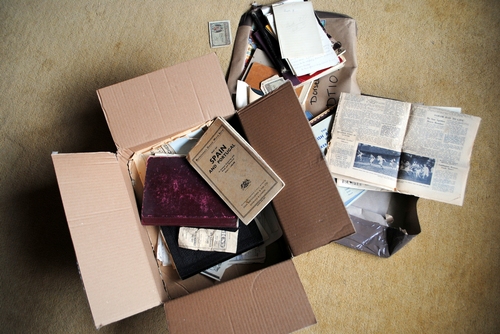
The 'box and contents' as delivered.
What was in the box?
There were lots of things in the box: half a dozen yellowed old newspapers; a few photographs; some Spanish and German wartime banknotes; a regimental badge; letters from home; and most numerous, a couple of dozen notebooks, most filled from front to back with Ray Bailey's neat pencilled handwriting.
Almost all the items in the box would ultimately find a place in Ray's story but it was the notebooks that were of central importance. Sixteen of them contained the complete story of 21 year-old Ray's escape from a prisoner-of-war column in northern France in the summer of 1940, and his epic journey the entire length of France and Spain to the British enclave of Gibraltar. From Gibraltar he was repatriated to the UK. All told, these sixteen notebooks contained over 80,000 words, making Ray's account of his experiences about the length of a medium-sized novel. In other words, pretty much the ready-made manuscript of a book. I could barely believe what I had unearthed.
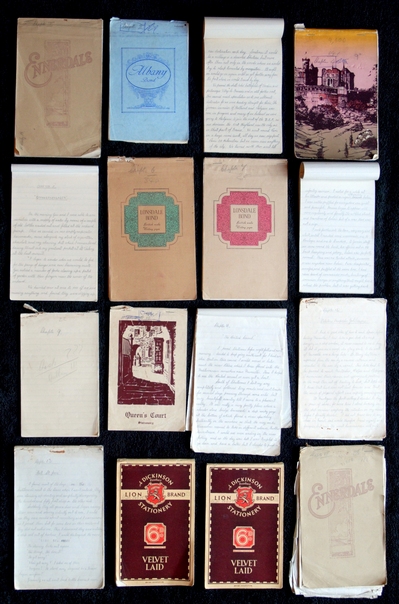
Ray's original manuscript in 16 notebooks.
Ray's story is constantly engaging. It is honest, thrilling and funny - and shot through with Ray's unshakeable belief that he will make it all the way home. Of course, Ray has to be tough and resilient to succeed - but his driving force is the devil-may-care optimism of youth. He gets in and out of numerous scrapes, often more by luck than judgement. And yet there is a absolute human centre to all of his adventures. Ray is sheltered, fed and clothed (and on more than one occasion, actively rescued) by ordinary French and Spanish working people; people like himself, and his mum and dad. These people have little enough to spare and expect never to see Ray again, yet they treat him with warmth and affection. It took no small degree of courage to assist an escaped British PoW in France or Spain in 1940. Ray is lucky in more ways than one - and to his credit, he knows it.
Editing Ray's Story
As I have said, Ray's story was complete - but that did not mean that I could simply type it up and try to interest a publisher. I had decided pretty much as soon as I read it that it had the potential to appeal to a wide readership - and it wasn't long before it became something of an obsession with me to get Ray's story out into the public domain. But there was lots of work to do before I could make that happen.
First and most obviously, I did have to type the story out. I began doing that sometime in the Autumn of 2019. It took several weeks of slogging away at the keyboard before I had copy-typed the whole 80,000 words. Next I had to edit the typescript. For a young man who had almost certainly left school at age 15 and who was only 22 when he wrote the manuscript and who, moreover, was writing under wartime conditions, Ray's prose is extraordinarily good. His account of his experiences has genuine narrative force and written, as it was, so soon after the events it describes, it has a sense of immediacy that is rarely found. Ray does nothing fancy with his words. He describes events simply, succinctly and in the order that they happened. He does this very well, in nicely constructed sentences and with a natural feel for the rhythm of language. For the kind of story he is telling, this is the perfect approach.
In terms of the nuts and bolts of Ray's writing, I tried to keep to an absolute minimum the editing that was necessary. I made no large scale interventions at all and changed language, construction or grammar in the fewest places necessary - and then to do no more than “tidy up” the occasional difficult-to-follow sentence or paragraph. I also shortened a fair number of Ray's longer sentences; he had a tendency sometimes to describe events in chains of phrases linked by conjunctions such as “and” or “but”. I split sentences of this type into two or three shorter sentences. My only aim in making the few changes described above was to improve readability. None of these changes altered the meaning or mood of Ray's writing in any way.
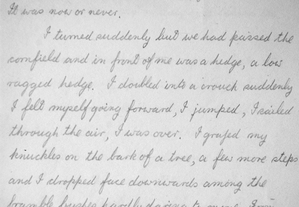
Ray's neat handwriting.
I was rather more interventionist in relation to the dates of the events Ray describes. In the entirety of the original manuscript Ray gives only one specific date (for those who like to know these things, the date concerned is October 10th 1940, which appears of page 266 of both the hardback and paperback editions of the book). I was however, able to establish accurate dates for many of the events Ray describes by painstakingly cross-referencing his account with a number of other sources, for example, the official history of the Kensington Regiment in WWII. I also had the benefit of a tiny pocket notebook kept by Ray himself. This notebook was among the odd extra bits and pieces that came along with the manuscript in the original auction lot. It wouldn't be true to say that Ray used this little notebook as a diary - his entries in it are far too sporadic for that - but helpfully, it does give dates for some of the events described in the final manuscript. I took the liberty of inserting these various dates directly into Ray's text. On every occasion but one therefore, whenever a date is given, those words are my additions (e.g. “The next day, 30 September …”).
A second group of practical changes relates to place names. In his original manuscript Ray frequently misspelled French and Spanish place names. These misspellings are particularly commonplace once he gets to Spain, indeed it is barely an exaggeration to say that only “Barcelona” and “Madrid” are spelled correctly in the whole of Ray's account of his Spanish adventures! Sometimes Ray uses rough phonetic approximations of place names. In other cases, he spells the name almost, but frustratingly often not quite, correctly. Via the magic of Google Maps, I have been able to give each location its proper name, even where it is just a tiny village. For anyone who wants to do so, it is now possible to track Ray's epic journey accurately on a map. Indeed, there is now an interactive map of Ray's journey on this very website*:
https://dw-writer.co.uk/longest-walk/map
My Contribution
I hope it's not immodest to say that I'm proud of creating The Longest Walk Home. My greatest satisfaction has been to bring Ray's inspiring story into the public domain - but I also in take pleasure in my own contributions to the book. About a quarter of the words in the book are mine. They are added only to give context to Ray's experiences and I like to think Ray would have welcomed the way they make his story more easily accessible to a contemporary audience. Remember that Ray completed his memoir before the war was even halfway through. He wasn't to know that it would be 85 years before his account of his experiences would emerge into the public domain. He saw no need to include background information about even very big things like - for example - the underlying political and social situation in Europe in 1940; his assumption, I'm sure, would have been that every likely reader would be familiar with these circumstances. And he could certainly never have envisaged that he would need to explain small details of everyday life and culture that are now long forgotten.
One of my editorial contributions therefore was to write notes on the text. These notes take two forms. The first set are brief scene-setting introductory notes that precede some of the chapters. The purpose of these notes is to give the reader sufficient background information to follow the story - and thus remain engaged with Ray's narrative - without needing to call on Professor Google. The second set of notes are added as endnotes at the end of the book. They provide background information that is interesting or relevant to what is happening in the story at the time. In a very small number of places I have also added a footnote at the bottom of a page. These footnotes are used to give information that is of immediate relevance to the story.
On a number of occasions, Ray refers by name to other soldiers. In the first part of the book, these soldiers are generally his comrades in the Kensington Regiment. Later, when he is on the run, there are times when he meets men from other regiments. My last contribution to the context setting notes therefore has been to put together an appendix, “Soldiers named in the manuscript”, which gives details of what happened to these individuals later in the war. Ray was a sociable character who made friends easily. He would be pleased I think, that as we picture in our mind's eye the men with whom he shared experiences, we are giving brief remembrance to their humanity too. Some of them did not live to tell their own story.
In addition to these various context-setting notes, I also added two short sections to the book. The first is a kind of prologue which introduces Ray to the reader and recounts what I was able to learn about his family history from public sources such as census data. This prologue also refers briefly to my discovery of the manuscript and summarises some of the other detail that I have given above. The second section I added is an Afterword, “After the Escape” which explains what I was able to discover about Ray's life after the great achievement of his escape.
The Long Road to Publication
As I mentioned earlier, I began the copy-typing of Ray's notebooks in the summer of 2019. It took me about a further eighteen months to turn the notebooks into a the final draft of a book. Quite apart from the editing I mention above, I had to undertake a significant amount of research to write the background material that I needed to add. I am retired from work so I have quite a lot of flexibility with my time but even so, I had to adopt an attitude of mind in which I treated the writing as pretty much as a job. At this point by the way, the book was titled Blighty or Bust, a rather pleasing phrase of Ray's from his original manuscript. I'll call the book by this title until the point where it acquired its new title quite some time later.
Blighty or Bust was not my first book. I'd had a book, also based on a found memoir, published some years before, in 2017. That book told a delightful story and had sold reasonably well but it was a more understated book - and certainly a less ambitious one - than Blighty. Nevertheless, that book had been accepted by the first mainstream publisher I sent it to. I soon came to realise however, that my modest previous success meant absolutely nothing. With Blighty or Bust, I firmly believed, I had a bigger, grander book, which gave insight into some fundamental human concerns such as the conduct of war, the kindness of strangers, the power of perseverance; and the triumph of the human spirit. Not only that, the book came with a story of its own. It was written by a 22 year-old working class lad who was a serving soldier on active service; it was probably the earliest memoir by a WWII British soldier to have been written and Ray was probably the youngest ever soldier to write a book length account of his experiences, Furthermore, the story had been lost for over 80 years before by a miraculous stroke of luck, falling into the hands someone capable of turning it into a book. It sounds naïve in retrospect but I thought that any good publisher would see that everything about the book was gold-dust.
But no. Over the next three years I sent submissions to numerous publishers, sticking closely to the individual and idiosyncratic rules that each different publisher had. A minority declined politely but from others I had neither acknowledgement nor notification of rejection. As everyone says, finding a publisher can be a soul-destroying process. By the beginning of 2023, I was seriously considering giving up on the whole project.
Luckily, I have a long-time friend, Jim Pollard, who is an experienced journalist and writer. Jim has published both fiction and non-fiction, some with mainstream publishers, others from his own small publishing imprint, Not Only Words. Jim has much more experience with the world of publishing than I do and I'd sought advice from him a number of times while I was developing Blighty or Bust. He now came up with an inspired solution; that between us we could bring Blighty to market ourselves.
So, that is exactly what we did - and I should say straight away, that without Jim's involvement, the book as it now is would simply not exist. Over the next six months or so, the two of us did nearly all the work that a big publisher would do. We began with a hard-headed edit of my contributions to Blighty to ensure that they were as clear and succinct as possible. Jim has professional type-setting software at home, and did a first class job of laying out the text. I took photographs and sourced period images from photo-libraries. We both proof-read the final draft again and again, and made it as near perfect as any two non-professional proof-readers could do. Then I got friends and relatives to proof-read it too. Jim designed the cover and I wrote the various blurbs and media releases that are necessary for promotional purposes. We also found an excellent company that could provide the services Jim and I could not. These were printing, distribution and sales management, plus the various necessary registration processes that make a book available to the retail trade. I had to fork out the cash for these various services of course but I figured that if Ray could escape the Nazis, cross the Pyrenees in worn-out street shoes and go days without food, then it really wasn't too much for me to expect of myself to put my money where my mouth was.
We published Blighty or Bust in August 2024. I did a fair amount of promotional work in the first few weeks that resulted in a articles in local newspapers. I also did two or three local radio interviews. Perhaps the biggest thing I did at that stage though was an hour long interview with the popular podcast, For You The War Is Over, which specialises in WWII escape stories. A noticeable spike in sales followed that. Virtually all sales of Blighty were via Amazon although a small number of people did order copies through Waterstones or their local indie bookshop.
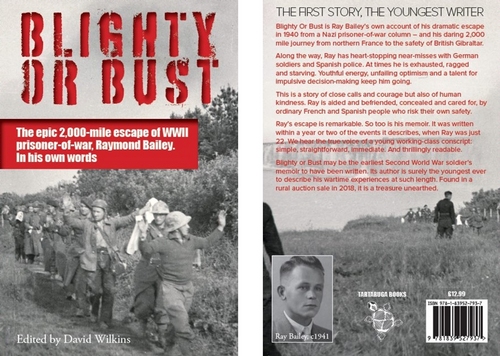
Front and back cover of Blighty or Bust.
Blighty received positive reviews on Amazon from the very beginning. which probably had the effect of generating more sales. That was all very heartening but the book's two big breaks came in September and October 2024 respectively. One of the local radio interviews I had done was with BBC Three Counties Radio, which covers the area in which Ray grew up. A few days after the interview, the journalist rang me to explain that the BBC News national website had picked up his Three Counties story and was considering posting it online the following Sunday. I don't mind saying that I visited the BBC site numerous times that morning - and sure enough at about 11:00, the article appeared. Ray's photo and his story were on the front page of BBC News online!
Unbelievably, by that evening Blighty or Bust had risen from lower than 300,000th best-selling book on Amazon to being the 87th. And in case you think that 87th still doesn't sound that impressive, consider that at any one time Amazon Books claims about 30 million titles as available on its UK site. 87th was not too bad for a book put into publication by a couple of blokes working from their kitchen tables. Of course, Blighty couldn't hope to stay at such a rarified level for long. We didn't have the marketing capacity to capitalise. Nevertheless that did kick things off and sales were to continue pretty reasonably with at least 3 or 4 books selling every day for the next several months. I don't have accurate sales figures but it also seems probable that in the first four or five days following the BBC article, Blighty sold several hundred copies.
And yet that BBC coverage wasn't even the biggest break of all. Three weeks or so after it appeared online, I was contacted by a senior non-fiction editor at Quercus Books. She had seen the BBC article and bought a copy of the book to check it out. Blighty had made a sufficiently good enough impression for her to email me to discuss the possibility Quercus might re-publish the book. Her suggestion was that that we make some modifications to the content and the marketing approach in order to present the book rather more as a human interest story and somewhat less as a work of military history.
I had no hesitation in taking up this offer. Quite apart from anything else, I was extremely positive about the idea of gently repositioning the book in the marketplace. I had believed from the beginning that the core of Ray's account was his personal story of self-belief and resilience, and his experience of the kindness of strangers during the very worst of times. I knew that Jim felt the same way - indeed we had deliberately emphasised these aspects of the book ourselves both in the back cover blurb of Blighty and in the media releases that we had put out. Quercus's suggestion of course did not affect Ray's original content at all. Ray's words were to remain as intact and original as they always had.
... Another cardboard box
It took me around six months to adapt the book along these slightly different lines. While I was doing that the efficient machinery of publication began whirring away in the background. The whole process seemed to fly by. And then, one day, a new and different cardboard box was delivered to my door. This one contained my author's complimentary copies of the new version of the book. Ray's story, now retitled The Longest Walk Home, was published in hardback in September 2025 and in paperback in May 2026. It is also available in Kindle and Audible formats, and in some overseas markets including the USA, Australia and New Zealand, as well as in the UK and Ireland. Should you want a copy, the book is available through all the usual outlets …
Links
If you have any comments, questions or observations, please feel free to email me at david@dw-writer.co.uk
Interview with the 'For You The War Is Over' podcast
Interactive map of Ray Bailey's escape journey*